More Than One Way to Serve | Veterans Day at MIRCI
November 11, 2026
When most people think of military veterans, words like strength, discipline, and toughness often come to mind. Sierra would like to add another word to that list: compassion.
"Most people see veterans and service members as really hard and disciplined," she says. "But I'm really compassionate and caring with the clients. Some people would even say that I'm a softie."
It's a description that might surprise someone who knows Sierra only from her military background. But for those who work alongside her at MIRCI, compassion is an essential part of the care she brings to people navigating mental health challenges.
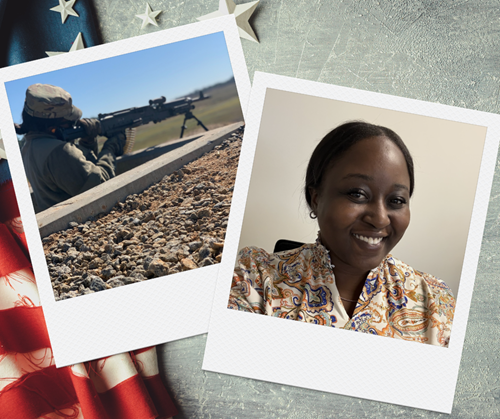
And while her Army uniform has been retired for three years, her commitment to serving others hasn't gone anywhere.
A Different Kind of Service
Sierra's military career looked quite different from the work she does today.
As a generator mechanic in the U.S. Army, she spent her days working with electrical and mechanical systems, often in demanding conditions. It was technical, physically demanding work that required discipline, attention to detail, and teamwork.
Social work wasn't exactly part of her original career plan.
"Absolutely not," Sierra laughs when asked whether she ever imagined herself working in the field while serving. After years of working outdoors and getting her hands dirty, she knew she wanted something different. What she didn't necessarily anticipate was how much of her military experience would follow her into her new career.
Finding Balance, Building Resilience
Today, Sierra serves as a case manager on MIRCI's Assertive Community Treatment (ACT) team, working directly with people experiencing significant mental health challenges. The work takes her into the community and into clients' homes, where relationships are built through trust, consistency, and a willingness to meet people where they are. Her military training continues to influence how she approaches that responsibility.
As a mechanic, following safety procedures was essential. Working with electricity meant understanding the risks, anticipating problems, and knowing that skipping a step could have serious consequences. That attention to safety and preparation remains important in her work today. But perhaps the most meaningful lesson Sierra carries from her military service is resilience.
"We can't control everything in life," she explains. "But just being resilient and being able to bounce back."
For clients navigating trauma, mental health challenges, and the uncertainties of everyday life, resilience isn't about pretending difficulties don't exist. It's about learning to adapt, finding ways to move forward, and recognizing that setbacks don't have to define the future.
Sierra sees her role as helping clients find structure without rigidity, creating routines that offer stability while leaving room for life's unpredictability. It's a thoughtful balance between order and flexibility, something her military experience helped her appreciate. And sometimes, the most meaningful contribution is also the simplest.
"Being a dependable person for the clients," Sierra says, is one of the most important ways she supports their stability and recovery.
The Strength to Be Vulnerable
For Sierra, one of the greatest contrasts between military and civilian life is the freedom to step outside the expectations that often accompany being a soldier. During her service, mental health resources were available, but seeking support wasn't always openly embraced.
"You didn't want to have a label," she recalls. "So you kind of masked it to get through."
She believes the expectation that service members must always be strong can make it difficult to acknowledge their own struggles.
"I don't always want to be a soldier," she explains. "I should be able to have vulnerable moments."
It's a perspective that resonates deeply with MIRCI's mission.
Mental health challenges don't disappear because someone is disciplined, capable, or accustomed to difficult circumstances. And strength isn't measured by how much someone can endure without asking for help.
Today, Sierra encourages others, particularly fellow veterans, to recognize the importance of advocating for their mental health and using the resources available to them. Her experiences have given her an appreciation for the courage it can take to acknowledge a need for support, as well as the difference that support can make.
A Broader Understanding of Homelessness
Working at MIRCI has also given Sierra opportunities to consider the challenges facing veterans and others experiencing homelessness. She believes conversations about veteran homelessness need to look beyond stereotypes and consider the complicated relationship between housing affordability, income, mental health, and access to benefits.
"Don't make assumptions," she says, particularly about substance use or mental health being the cause of someone's homelessness.
Sometimes, she explains, the circumstances are painfully straightforward. A person simply doesn't have enough income to cover housing, food, medication, and other necessities.
For veterans, navigating benefits and documenting service-related health concerns can create additional challenges. It's an issue Sierra hopes to address more directly as her career develops. One of her long-term goals is to work with veterans and service members, helping them advocate for themselves and better understand the importance of documenting physical and mental health concerns during their service.
She sees that kind of early advocacy as one way to help prevent future instability and homelessness. Her perspective is rooted in a simple belief: those who have served their country deserve access to the resources and opportunities necessary to build stable lives afterward.
Service Doesn't End with the Uniform
There are parts of military life Sierra still misses, especially the friendships and sense of shared responsibility. Many of her closest friends today are people she met while serving. There are also some things she's happy to leave behind, including the early mornings, crowded living quarters, and lack of personal space. A few habits, however, remain firmly intact.
She still likes things to be coordinated and orderly, a preference she jokingly traces back to military life. And after years of having only minutes to finish a meal during training, she admits she's still a remarkably fast eater. But beneath those everyday reminders of her Army years is something more lasting: a belief in responsibility, teamwork, and looking out for others.
In the military, that meant supporting the people serving alongside her and helping prepare the way for those who would follow.
At MIRCI, it means showing up for clients, helping them find stability, and reminding them that recovery and progress are possible.
The work may look different, but the commitment is familiar.
And perhaps that's what makes Sierra's story such a meaningful reflection on Veterans Day.
There is more than one way to serve. Sometimes service means wearing a uniform. Sometimes it means showing up at someone's door, offering a little structure in an uncertain world, and being someone they can count on.
This Veterans Day, MIRCI proudly honors Sierra and all the veterans on our team who continue to serve their communities with compassion, dedication, and care.
Their military service may be behind them, but their service to others continues every day.


